SDCA Registers Six New Utility Models with IPOPHL
St. Dominic College of Asia (SDCA), through its Research Innovation and Development Enterprises (RIDE), has registered six new utility models with the Intellectual Property Office of the Philippines (IPOPHL), marking another development in the institutions continuing efforts to translate research into protected and potentially applicable innovations.
Registered on July 31, 2026, the utility models focus on transforming agricultural materials and by-products into value-added food products. The registered innovations cover mango seed drip coffee, chicken feet gummy candy, and jackfruit seed spread, with registrations encompassing both their formulations or compositions and methods of production.
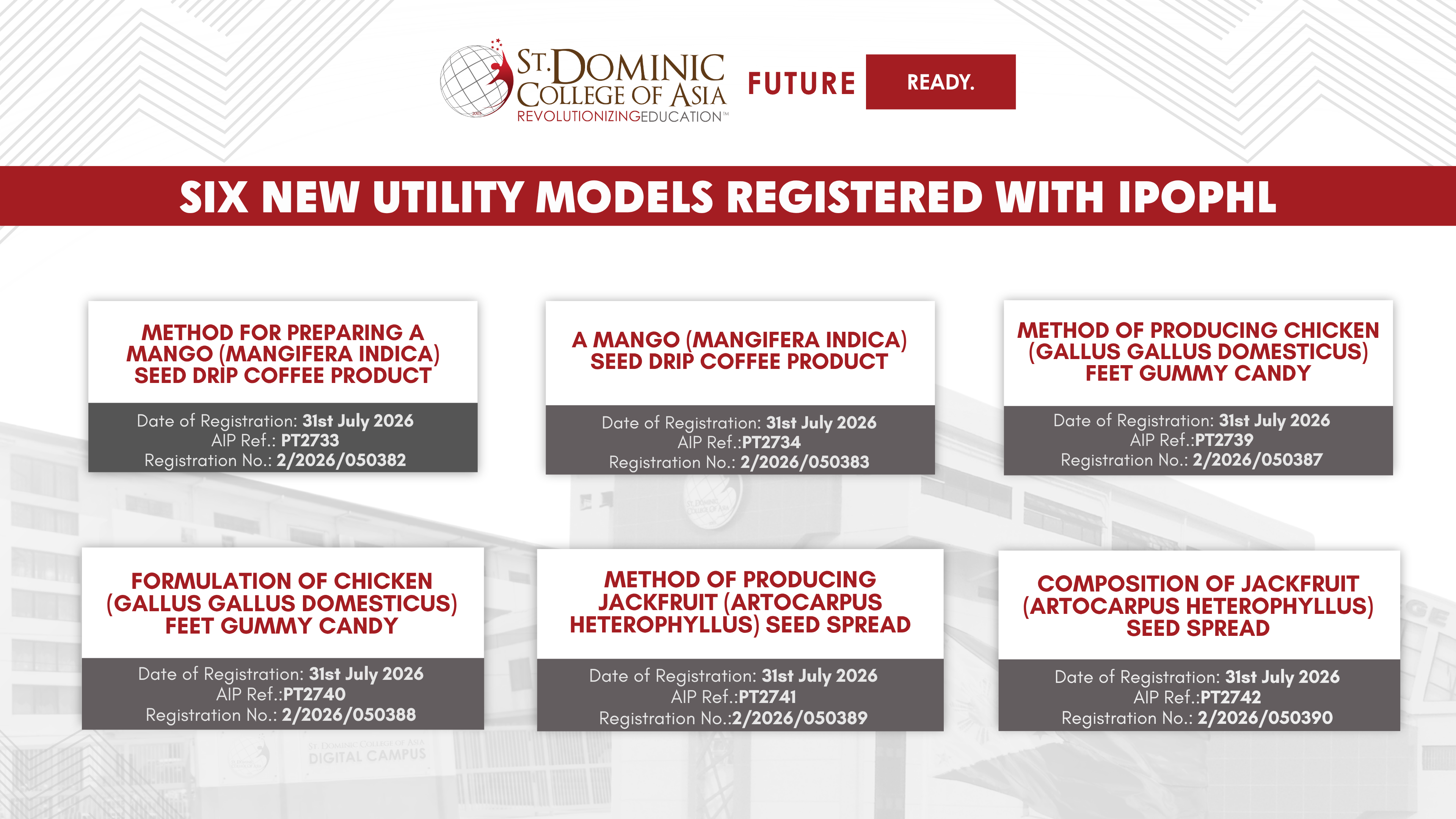
The six registered utility models are:
Method for Preparing a Mango (Mangifera indica) Seed Drip Coffee Product Registration No. 2/2026/050382
A Mango (Mangifera indica) Seed Drip Coffee Product Registration No. 2/2026/050383
Method of Producing Chicken (Gallus gallus domesticus) Feet Gummy Candy Registration No. 2/2026/050387
Formulation of Chicken (Gallus gallus domesticus) Feet Gummy Candy Registration No. 2/2026/050388
Method of Producing Jackfruit (Artocarpus heterophyllus) Seed Spread Registration No. 2/2026/050389
Composition of Jackfruit (Artocarpus heterophyllus) Seed Spread Registration No. 2/2026/050390
The registrations reflect the practical direction of research at SDCA, particularly in exploring how materials that may otherwise be underutilized can be developed into food products with potential for further application and commercialization. By securing intellectual property protection, these research outputs also take an important step beyond academic development toward possible technology transfer and wider use.
Through RIDE, SDCA continues to support research initiatives that respond to areas such as sustainable resource utilization, food innovation, and value creation, while strengthening the connection between academic research and real-world applications.
The registration of the six utility models recognizes the work of the Dominican researchers and innovators behind these developments and contributes to the institutions growing body of protected intellectual property.